


2025 Guide for Swim Schools and Coaches
In 2025, more swim school owners in Malaysia are asking how to automate swimming class scheduling and payments in Malaysia. Automating these processes is no longer a luxury for large academies only. It has become a necessity for any school that wants to grow without being buried under manual admin work.
Automation helps swim schools save time, reduce human error, and improve the overall experience for students and parents. This guide explains what automation really means in the Malaysian context, why it matters financially and operationally, how to implement it step by step, and how to choose the right software. It also includes future trends and frequently asked questions to help you make an informed decision.
Why is Automation Urgent?
Malaysia’s digital transformation is accelerating rapidly
According to the Malaysian Government’s Digital Investment Report, the country attracted RM66.22 billion in digital investments in just the first half of 2024, already surpassing the full-year total for 2023. This growth shows how strongly Malaysia is investing in digital transformation across all sectors.
The Department of Statistics Malaysia further reported that ICT and e-commerce contributed 23.5% to the nation’s GDP in 2023, generating over RM427 billion in value. This means nearly a quarter of the country’s economic activity is now digital.
For swim schools and academies, this is not just a technology story. It is a signal that parents, students, and partners increasingly expect digital convenience, from online booking to cashless payments.
The health and fitness sector is growing and getting more digital
Malaysia’s health and wellness market reached USD 11.42 billion in 2024 and continues to expand steadily. Globally, fitness and wellness software is expected to grow from USD 81.9 billion in 2024 to USD 133.7 billion by 2030.
In Malaysia, boutique gyms, yoga studios, and swim schools are part of this movement. Many of these operators still rely on WhatsApp messages, spreadsheets, and manual transfers to manage bookings and payments. While that may work for a few dozen students, it quickly breaks when enrolment grows. This is where automation becomes essential.
Why Automating Scheduling and Payments Matters for Swim Schools
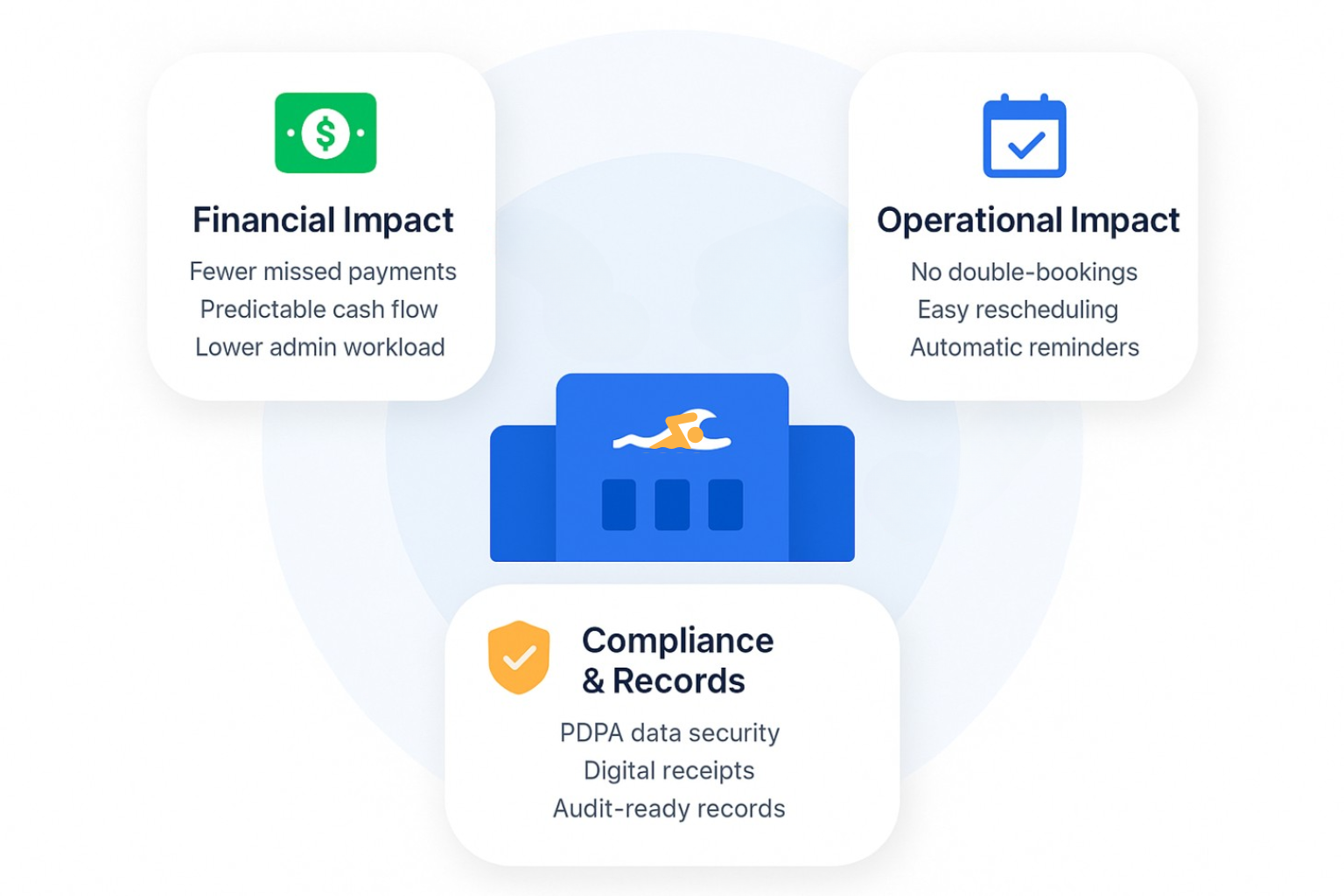
Automation affects three key areas: finances, operations, and compliance.
1. Financial Impact
Automating scheduling and payments directly improves your revenue consistency and reduces administrative costs.
- Fewer missed or delayed payments: Automated systems can charge or remind customers on time, ensuring that every class booked is paid for. This eliminates the awkward task of chasing parents for fees.
- More predictable cash flow: When renewals and billing cycles are automated, your income becomes more stable. You can forecast revenue more accurately, which helps in planning staff schedules and marketing budgets.
- Lower administrative workload: Staff who previously spent hours reconciling payments, tracking attendance, or updating spreadsheets can focus on sales, student engagement, and retention instead.
- Faster growth with fewer hires: You can add new students or even open another location without needing to double your admin team.
2. Operational Impact
Automation helps streamline daily swim school operations, ensuring smoother coordination between coaches, students, and parents.
- Fewer scheduling errors: Automated systems prevent double-bookings and alert you if two classes overlap or exceed pool capacity.
- Easier rescheduling: Parents can cancel or reschedule within the app, which automatically adjusts attendance and credit balances.
- Consistent communication: Students receive automatic reminders for upcoming lessons, renewals, and class changes, reducing no-shows and confusion.
- Improved reporting: Real-time dashboards help you spot attendance patterns, most popular class slots, and under-utilised times that could be repurposed.
3. Compliance and Record-Keeping
Swim schools collect personal data such as names, contact details, and sometimes medical information. Under Malaysia’s Personal Data Protection Act (PDPA), this information must be stored securely.
- Automated systems reduce risk: Platforms like vibefam use secure data encryption and restricted access to protect sensitive details.
- Transparent billing: Automatic receipts and digital transaction records create a clean audit trail for finance and tax purposes.
- Regulatory readiness: Digital records make compliance audits and insurance claims faster and less stressful.
Automation is therefore not only about saving time. It also builds credibility and trust with parents and partners.

How to Automate Swimming Class Scheduling and Payments in Malaysia: A Step-by-Step Guide
This framework helps you move from manual to automated operations in an organised, low-risk way.
Step 1: Map Out Your Existing Workflow
Before introducing any software, document what you currently do manually. List out every step in your booking and payment flow:
- How you create and update class schedules
- How parents register new students
- How payments are collected and recorded
- How attendance and cancellations are handled
- How reports or summaries are produced
By laying this out, you’ll quickly see where human error or delay occurs. Those weak points are what automation should target first.
Step 2: Start with a Small Pilot Group
Do not roll out automation to every student immediately. Choose one category, such as beginner classes, and pilot the system there. This allows your team to get used to the process and iron out issues before scaling.
During the pilot, measure how many hours are saved and whether any parent complaints arise. This data will help convince staff and management to adopt it across all programs.
Step 3: Digitise Your Class Schedule and Packages
Transfer all your class information into the software, including class name, day, time, duration, and capacity. For swim schools, many systems like vibefam allow you to define class packs or memberships, such as “10-class packages” or “monthly subscriptions.”
You can also enable automatic credit deduction, so when a student books a class, the system deducts the correct number of credits. If you offer renewals, set up automated reminders that notify parents before their packages expire. These small automations save hours of follow-up and reduce lost revenue.
Step 4: Integrate Local Online Payments
Payments are often the most complex part of automation because they must work with local preferences.
vibefam supports FPX and GrabPay for Malaysia-friendly checkouts, which covers the majority of local users. If your students commonly use DuitNow QR, you can contact vibefam to confirm whether that gateway is also supported.
After linking your payment account, test different transaction types, such as full payments, renewals, and refunds, to ensure reconciliation is accurate. Confirm that both you and your customers receive clear receipts.
Step 5: Train Your Staff and Inform Parents
Even the best system will fail if users don’t understand it. Train your coaches and administrators on how to book, cancel, or check attendance within the app. Prepare simple guides or short videos for parents explaining how to use the booking platform.
Send emails and in-app messages announcing the change and include a short FAQ about new policies, payment options, and rescheduling rules. When people know what to expect, adoption happens smoothly.
Step 6: Monitor and Refine the System
Automation is not a one-time project. Review performance regularly:
- Class occupancy: Identify popular and under-filled classes.
- No-show and cancellation rates: Adjust policies or send reminders.
- Payment success rates: Ensure gateways are working efficiently.
- Feedback: Ask parents and staff about ease of use.
Use this information to tweak your schedule, add features, or adjust class sizes. Continuous improvement ensures that automation truly delivers value.
Step 7: Scale and Connect Other Systems
Once your main workflow runs smoothly, consider integrating other tools such as CRM software or marketing automation. You might link email campaigns to send welcome messages or promotional offers to inactive students. The goal is to build one connected ecosystem instead of separate tools that don’t talk to each other.
Common Mistakes When Automating a Swim School and How to Avoid Them
Automation can simplify your business, but only when implemented correctly. Here are the most frequent mistakes and how to prevent them.
Skipping planning and jumping straight into a tool
Many owners sign up for a platform without analysing their current operations. This leads to confusion about what problems the tool is supposed to solve.
How to avoid it: Take time to map every manual process and identify where automation provides the biggest payoff.
Poor communication with staff and parents
When change happens suddenly, both staff and students may feel lost.
How to avoid it: Communicate early and provide easy-to-follow instructions. Offer a grace period where both manual and automated options are available.
Incomplete configuration of class and payment rules
If you do not define clear refund, make-up, or credit rules, you risk disputes and unhappy customers.
How to avoid it: Document your policies first, then configure them in the software and test every edge case.
Ignoring failed payments or technical errors
Every system encounters payment declines or connection issues occasionally.
How to avoid it: Enable automatic retries and ensure that the system sends payment failure notifications. Keep an eye on your reports so that no transaction is missed.
Underusing reports and dashboards
Some schools only use automation for bookings and ignore analytics.
How to avoid it: Review your reports weekly to understand revenue trends, attendance, and coach utilisation. Use insights to adjust schedules or marketing campaigns.
Choosing software that cannot grow with you
A system that fits a small studio might struggle when you expand.
How to avoid it: Always check scalability, API options, and multi-location features before committing.
By addressing these common pitfalls early, you can ensure your automation journey is efficient and stress-free.
How to Choose the Right Automation Platform for Your Swim School
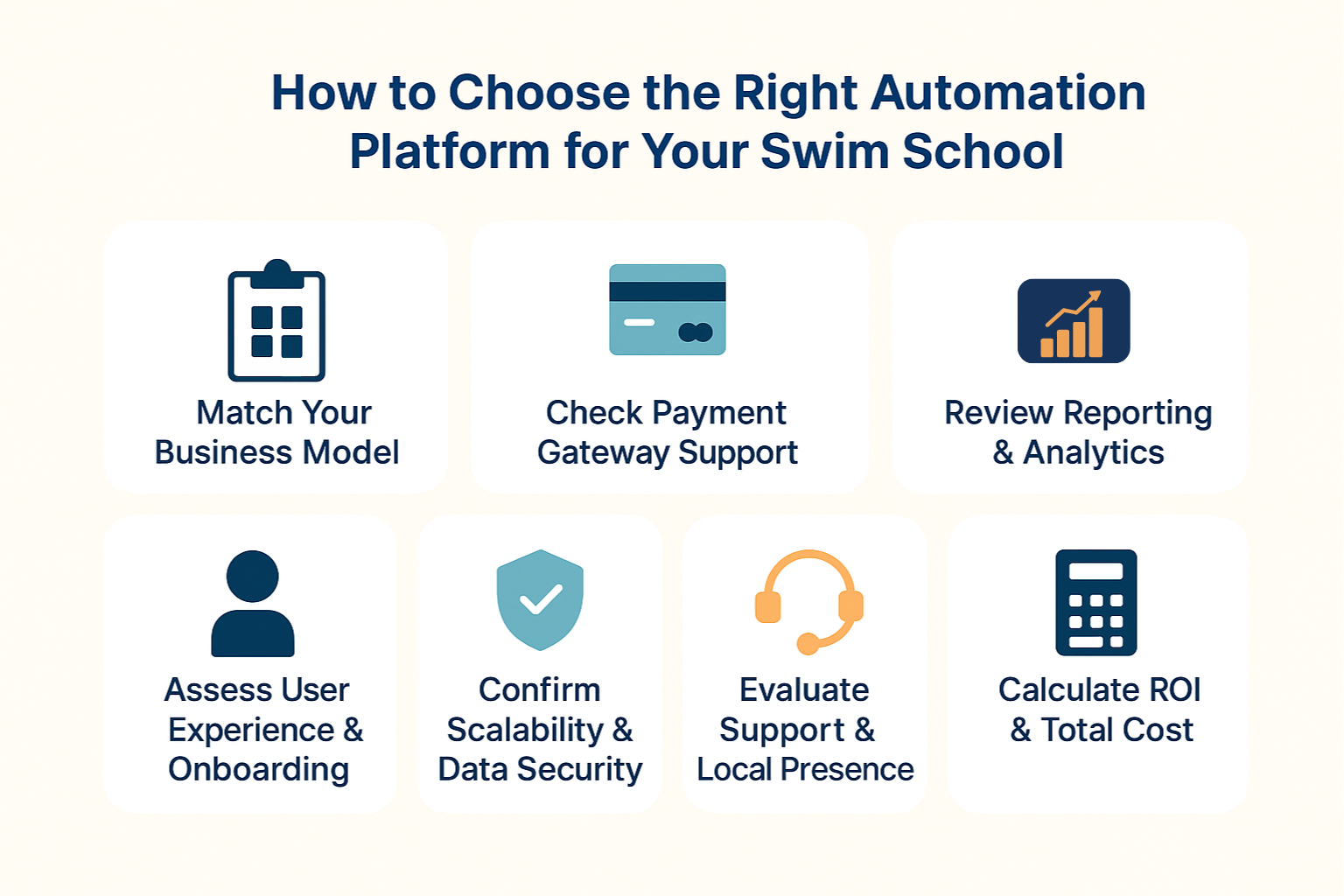
Evaluate Based on Your Business Model
Look for a system that matches the way you operate. If you sell class packs, ensure it supports credit deduction and expiry tracking. If you prefer memberships, confirm that it can handle automated renewals and recurring billing. If you have family accounts, ensure multiple students can share one parent login.
Check Payment Gateway Support and Accounting Fit
For Malaysian businesses, local payment options are crucial. Ensure that FPX and GrabPay are supported, and ask the vendor about DuitNow QR if your customers use it frequently. Also confirm that invoices, receipts, and financial summaries can be exported for your accounting software or audits.
Review Reporting and Analytics Capabilities
Good software gives you real-time visibility into attendance, cancellations, and revenue. It should also highlight your busiest hours or coaches so you can optimise resources. vibefam, for example, offers a “Leading A.I. Business Dashboard” that provides insights and recommendations.
Assess User Experience and Onboarding
Your team should be able to learn the system in a day, not a month. Look for clear navigation, mobile-friendly design, and training resources such as videos or FAQs. If students or parents find the booking process confusing, adoption will drop.
Confirm Scalability and Data Security
If you plan to expand into multiple locations, ensure that the system supports multi-branch management. Also check that data is stored securely, encrypted, and compliant with PDPA. Ask vendors for documentation on how they protect user information.
Evaluate Support and Local Presence
Reliable customer support is key. While vibefam lists regional payment support for Malaysia, you can contact them to confirm whether they provide direct local assistance. For other vendors, look for support hours that match your timezone and response guarantees.
Calculate Total Cost of Ownership and ROI
Do not just compare subscription prices. Include transaction fees, onboarding costs, and potential staff savings. For instance, if automation saves 40 admin hours a month, you can easily calculate payback time. Most schools recover their investment within months through reduced errors and faster payments.
To explore a ready-to-use platform that covers scheduling, payments, and analytics in one app, visit vibefam.
FAQs
1. How much does it cost to automate scheduling and payments with vibefam?
vibefam offers different subscription plans depending on the size of your studio. Most swim schools in Malaysia use the Professional Plan, which includes advanced features such as credit management, auto-renewals, and business dashboards. Pricing is listed in MYR and typically charged monthly. There are no hidden setup fees, and you can scale your plan as your swim school grows. You’ll also pay standard transaction fees to payment gateways like FPX or GrabPay. For exact pricing, visit vibefam.com or contact their team for a quote.
2. Can vibefam handle multiple branches or pools under one account?
Yes. vibefam supports multi-location management, allowing owners to run multiple branches or pool locations under a single dashboard. You can assign staff roles, manage separate class schedules, and view combined or branch-specific reports. This helps larger swim schools manage operations efficiently without having to juggle multiple systems.
3. How long does it take to set up vibefam for a swim school?
Most swim schools can be fully set up in two to four weeks. You’ll start by importing your class schedules and student data, then connecting your payment gateways such as FPX or GrabPay. The vibefam team provides onboarding support, and once your coaches and admin staff are trained, you can start accepting bookings almost immediately. Transition time may vary based on how complex your existing manual process is.
4. How secure are student and payment details on vibefam?
Data security is a key focus for vibefam. The platform uses secure cloud hosting and integrates only with trusted payment gateways such as FPX and GrabPay. This means payment information is processed through certified partners rather than stored locally. Personal and class data is protected through encrypted access. Swim schools in Malaysia can operate confidently knowing the system follows data protection best practices that align with the Personal Data Protection Act (PDPA).
5. What kind of reports and analytics will I get from vibefam?
vibefam includes Reports & Dashboards as part of its analytics suite. These tools show real-time data on class attendance, revenue, and package utilisation. The AI Business Dashboard also provides automated recommendations to help owners identify new growth opportunities, optimize class schedules, and improve overall studio performance. By analyzing real-time data across bookings, sales, and member behavior, it delivers actionable insights tailored to each studio’s unique operations. This helps the owners to make smarter and faster decisions that drive higher revenue and stronger member retention.
To explore how Vibefam can simplify your swim school operations, visit vibefam.com or book a demo to see how its scheduling, payment, and credit systems work in practice.
Final Recap: Making Every Swim Class Run Smoothly
Automation is transforming how swim schools in Malaysia manage their business. The national shift toward digital services, the rise in cashless payments, and the demand for convenience have created perfect timing to upgrade operations.
By automating scheduling and payments, you can:
- Reduce errors and save countless admin hours
- Improve customer satisfaction with faster booking and reminders
- Achieve consistent revenue and accurate reporting
- Stay compliant with data protection and billing standards
- Scale confidently as enrolment grows
Tools like vibefam already combine booking, scheduling, and payments in one unified workflow. With features such as automatic credit deduction, membership renewals, and real-time analytics, they help Malaysian swim schools operate more efficiently.
If you are ready to modernise your swim academy, begin by assessing your current workflows and mapping where automation can help. Then explore trusted platforms like vibefam and confirm which payment gateways and support options best fit your needs.
Start simplifying your scheduling and payments today. Contact vibefam to learn how their platform can help you save time and grow your swim school with confidence.