

Hiring the right instructor is one of the highest-leverage decisions a boutique studio makes. One great instructor fills a class and builds a following; one mismatched hire costs members and reputation. But most hiring guides skip the two questions owners actually ask first: what should I pay, and is this person an employee or a contractor? This guide covers pay benchmarks by discipline, how to classify instructors correctly, where to actually find them, and what separates a real interview from a formality.
How Much Do You Pay a Studio Instructor?
The U.S. Bureau of Labor Statistics puts the median annual wage for fitness trainers and instructors at $46,180 as of May 2024, with the bottom 10 percent earning under $27,580 and the top 10 percent over $82,050, per the BLS Occupational Outlook Handbook. Per-class rates at boutique studios vary far more by discipline than that broad government figure suggests.

| Discipline | Typical per-class range | Notes |
|---|---|---|
| Pilates instructor | $25 to $50 per class | Reformer-certified instructors tend to sit at the higher end |
| Yoga instructor | $25 to $37 per class | Rate often scales with certification level and class size |
| Group fitness instructor | $20 to $35 per class | Shorter formats (45 to 60 minutes) typically pay less per session than specialized reformer or private work |
These per-class figures come from self-reported salary aggregators like Indeed, ZipRecruiter, and PayScale, not a single authoritative source, and the spread across those platforms is wide. Treat them as a starting negotiation range, not a fixed rate, and check what comparable studios in your specific market are actually paying before you set your own.
Employee or Contractor: How Do You Classify Instructors?
The IRS uses a three-factor common-law test to decide whether an instructor is an employee or a contractor: behavioral control (do you set the schedule and teach format), financial control (can they work elsewhere and set their own rate), and the nature of the relationship (are they core to your regular schedule or brought in occasionally). [NEEDS VERIFICATION per jurisdiction and current guidance, rules outside the US differ]
In practice, an instructor who teaches your core weekly schedule, uses your studio's equipment, and has no ability to negotiate their own rate looks like an employee under this test, regardless of what a contract calls them. A specialist brought in for an occasional workshop who sets their own price and brings their own materials looks more like a contractor. Misclassification carries real financial risk, back taxes and penalties among them, so confirm your specific setup with an employment attorney or accountant rather than defaulting to whichever classification is more convenient.
Where Do You Find Great Instructors?
The instructors worth hiring are rarely sitting on a general job board. Three channels consistently outperform posting-and-praying: your own studio's existing client base (members who are certified instructors elsewhere are often your best hires, since they already know your brand and community), discipline-specific communities (fitness expos, certification-body directories, and Instagram or Facebook groups built around a specific format), and your studio's own careers page, which converts warmer than a cold job listing because applicants already know and like the brand. In our observations supporting boutique studios across North America and APAC, the strongest instructor hires almost always come from one of those three warm channels, rarely from a cold job-board post.
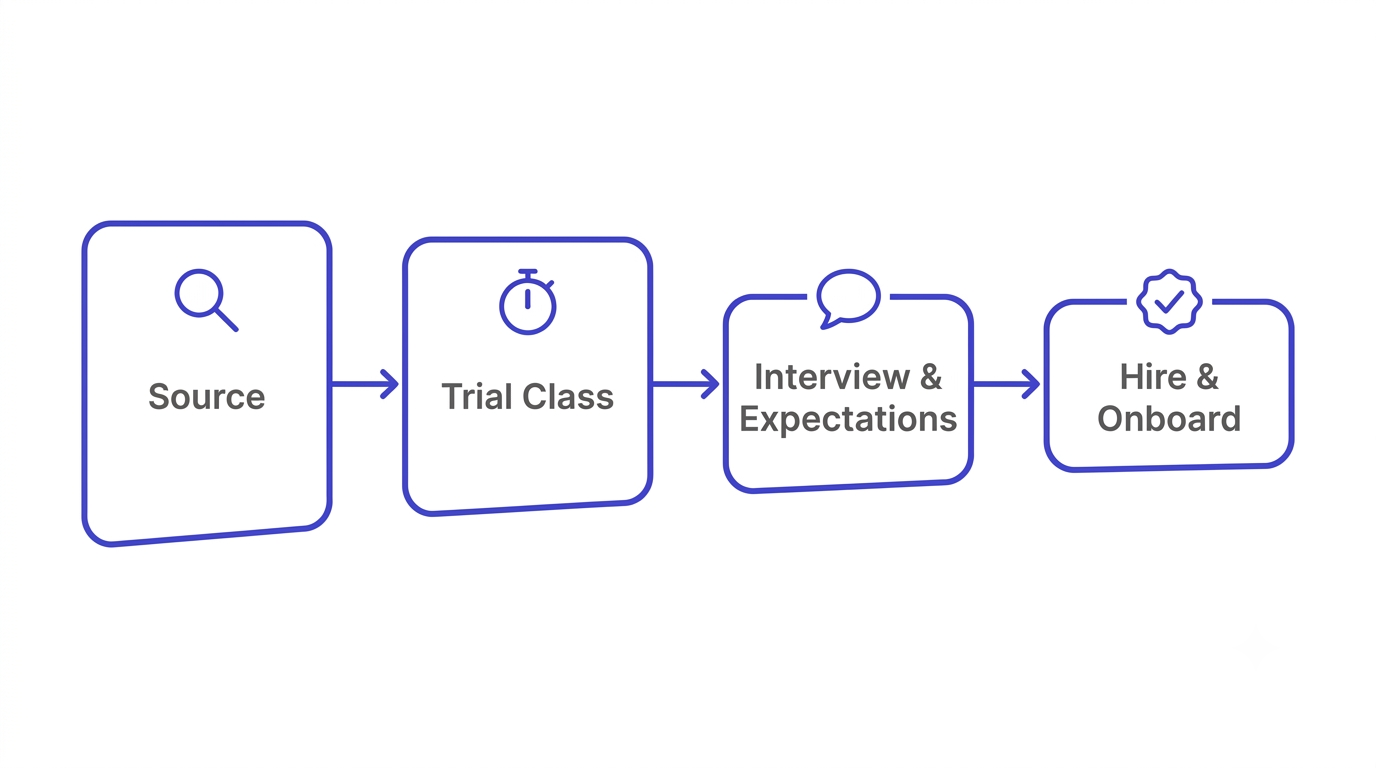
Market-specific hiring dynamics matter too. If you're hiring in Singapore specifically, where to find fitness instructors in Singapore breaks down the channels that actually work in that market. Treat recruitment like you'd treat sales: track your candidate pipeline, follow up, and keep good leads warm, since today's promising candidate is often tomorrow's hire once a spot opens up.
What Should You Actually Look For in an Interview?
A single trial class predicts fit better than any interview question, watching someone actually teach your members reveals things a resume and a conversation never will: pacing, energy, how they handle a room of mixed skill levels, and whether members respond to their style.
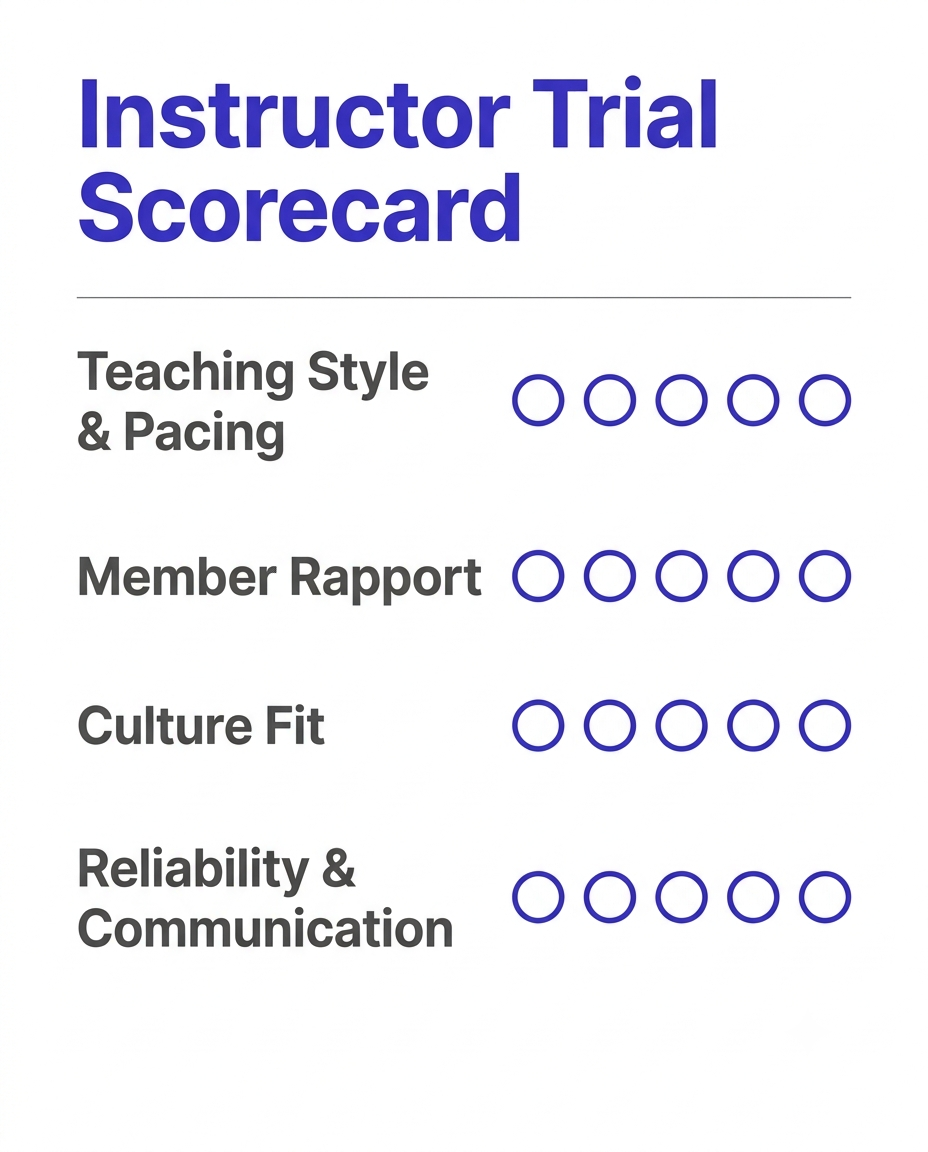
Before the trial, run a candid expectation-setting conversation in both directions: tell the candidate exactly what your studio's culture and schedule demands look like, and ask them what they expect from you in return. Test real scenarios during the interview itself, simulate a member asking about a fitness goal or a scheduling conflict, and watch how the candidate responds under a bit of realistic pressure rather than a rehearsed answer. Expectation mismatch, not lack of skill, is the most common reason a promising hire doesn't work out.
Pay Them Fairly, Automatically
Once you've hired the right instructor, the operational question becomes paying them correctly and on time, by class type, by attendance, by revenue share, without a manual spreadsheet reconciliation every pay period. In our observations supporting boutique studios across North America and APAC, this is the exact admin load that eats the hours an owner meant to spend recruiting the next great hire instead.
Vibefam automates payroll across class type, time, attendance, and revenue, with one-click timesheet export and instructor-performance reporting built in, so a studio running five instructors on five different pay structures isn't rebuilding that math by hand every two weeks. Vibefam gives boutique studios comprehensive software across operations and marketing, so instructor pay runs through the same system as your class schedule and member payments, not a separate tool you're stitching in. Book a free demo to see how instructor payroll would run on your own schedule.
The Real Cost of a Bad Hire
A mismatched instructor doesn't just cost you a single bad class, it costs member retention in a format where members often follow the instructor more than the studio brand, and it costs you the time spent re-recruiting and re-training for the same slot. Getting the pay benchmark, classification, and interview process right upfront is cheaper than fixing a hiring mistake three months in.
Instructor cost is also a direct input into your pricing math, if you're still working out what to charge for classes and packages, this pricing strategy guide and the operations and staff hub cover the adjacent decisions that hiring feeds into.