

How to Prepare for HYROX: A Complete Race Guide for 2026
You signed up for HYROX. Maybe a friend dared you, maybe you watched a video of someone dragging a sled and thought "I could do that." And now the race is on the calendar, the confidence has worn off, and you're staring at a workout you've never actually done: 8 kilometres of running broken up by eight strength stations, back to back, no rest.
Here's the good news. HYROX rewards preparation more than raw talent. It's the same eight stations at every race, in the same order, with the same weights for your division. Nothing is a surprise. Which means with a smart 8 to 12 week build, a first-timer can cross that finish line strong, not survive it.
This guide walks you through exactly how to prepare: the format, the weights, how to train, how to pace, and the mistakes that wreck most people's first race. Let's get you ready.
The quick answer: what HYROX actually is
HYROX is a fitness race. You run 1 kilometre, do one functional station, then run again, for eight rounds. Same sequence, every event, worldwide. Total: 8km of running plus eight stations, done for time.
The full sequence looks like this:
| Order | Run | Station | Distance / Reps |
|---|---|---|---|
| 1 | 1 km run | SkiErg | 1,000 m |
| 2 | 1 km run | Sled Push | 50 m |
| 3 | 1 km run | Sled Pull | 50 m |
| 4 | 1 km run | Burpee Broad Jumps | 80 m |
| 5 | 1 km run | Rowing | 1,000 m |
| 6 | 1 km run | Farmers Carry | 200 m |
| 7 | 1 km run | Sandbag Lunges | 100 m |
| 8 | 1 km run | Wall Balls | 100 reps |
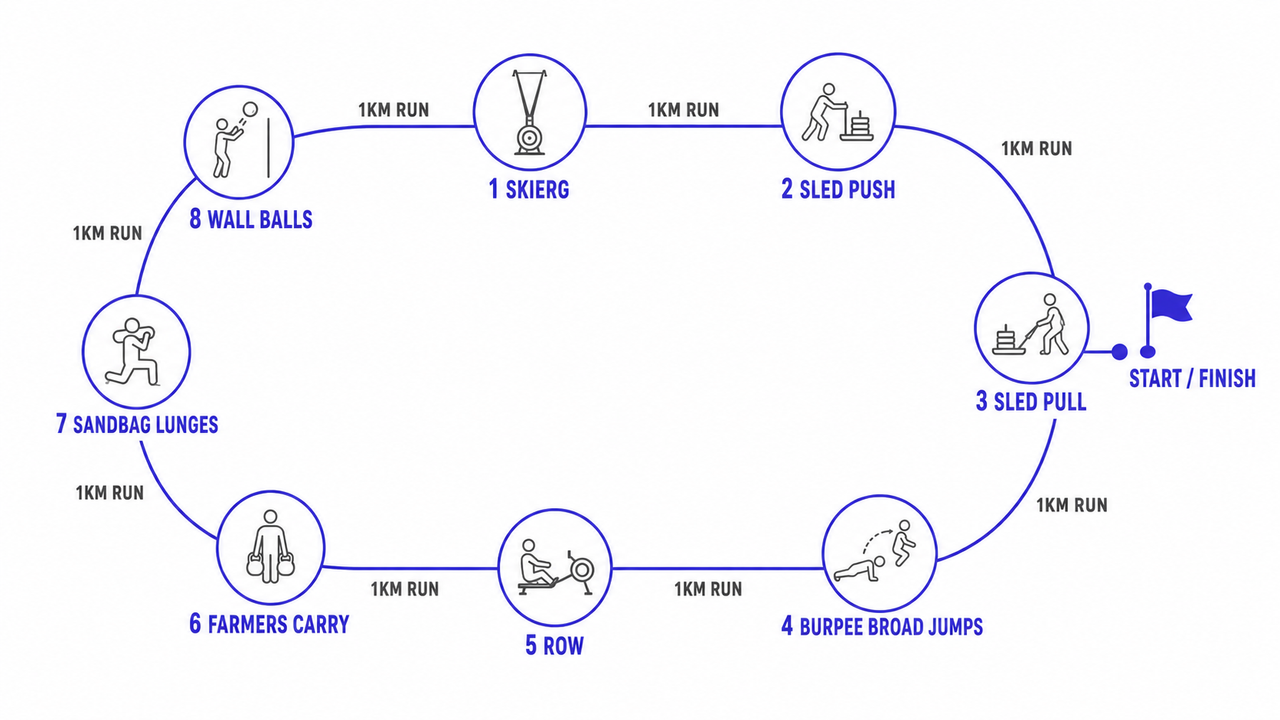
Between every run and every station sits the "roxzone," the transition area you jog through to get from the track to the next station. It sounds trivial. It isn't. More on that later, because it's where a lot of people quietly lose two or three minutes.
A typical first-timer finishes somewhere in the 90-minute to two-hour range. Strong age-groupers land closer to 60 to 75 minutes. Elite athletes go under an hour. Your goal for race one is one thing only: finish strong and enjoy it. The clock can wait for race two.
Why HYROX is harder than it looks on paper
Look at the stations individually and none of them is scary. A 1km run? Fine. 100 wall balls? Annoying but doable. A sled push? Sure.
Here's the thing nobody tells you. You never do any station fresh. You do the sled push after a run, with a heart rate already near threshold and legs that are half-cooked. Then you run again on legs that just got torched by the sled. This is called compromised running, and it is the entire sport in two words.
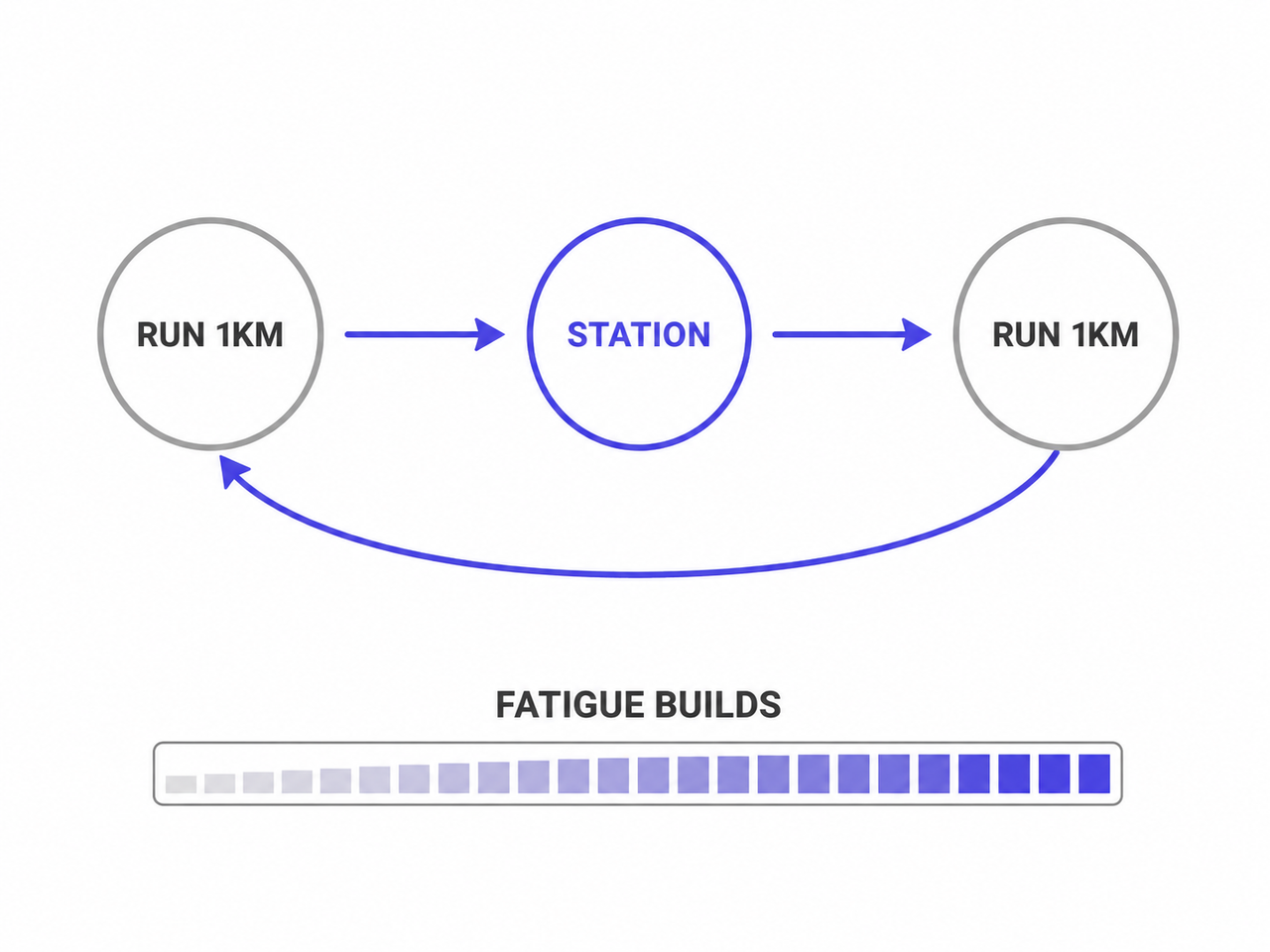
Most beginners train the pieces separately. They run on Monday, lift on Wednesday, and never once run hard immediately after a heavy leg station. Then race day arrives and that first post-sled run feels like wading through wet concrete, and they panic. Don't be that person. If you take one idea from this guide, take this: train the transitions, not just the parts.
Step 1: Learn the eight stations cold
You can't pace what you don't understand. Before you build a plan, know exactly what each station demands and what you'll be lifting on the day.
Weights depend on your division. Here are the Open and Pro loads for the strength stations:
| Station | Open Women | Open Men | Pro Women | Pro Men |
|---|---|---|---|---|
| Sled Push (50 m) | 102 kg | 152 kg | 152 kg | 202 kg |
| Sled Pull (50 m) | 78 kg | 103 kg | 103 kg | 153 kg |
| Farmers Carry (200 m) | 2 × 16 kg | 2 × 24 kg | 2 × 24 kg | 2 × 32 kg |
| Sandbag Lunges (100 m) | 10 kg | 20 kg | 20 kg | 30 kg |
| Wall Balls (100 reps) | 4 kg to 2.7 m target | 6 kg to 3 m target | 6 kg to 2.7 m | 9 kg to 3 m |
Sled weights include the sled itself, and HYROX has adjusted loads between seasons before. Confirm the current numbers for your specific event on the official HYROX site. [NEEDS VERIFICATION per event season]
The two ergs (SkiErg and Rowing) and the burpee broad jumps use no added weight, just your body and your engine. The SkiErg is 1,000m of double-arm pulling that lights up your lats and lungs early. The row is another 1,000m, and it lands at station five when you're already deep in the pain cave. The burpee broad jumps are 80m of burpee, jump forward, burpee, jump forward. They're the great equaliser, and they humble everyone.
Notice the design. The sleds hit early while you're fresh enough to move them, and the wall balls come dead last when your legs are gone and 100 reps feels like 300. That ordering is deliberate, and it should shape how you pace.
Step 2: Pick the right division
You don't race HYROX in a vacuum. You pick a category, and picking the right one matters more for a first-timer than almost anything else.
HYROX Open is where most people start. The weights are approachable, and you're racing the version everyone means when they say "I did a HYROX." If it's your first race, this is almost certainly you.
HYROX Pro uses heavier sleds and wall balls and is built for experienced, stronger athletes chasing rankings. Skip it for race one unless you already have a serious strength base.
HYROX Doubles is the smart first-timer move. You and a partner split the reps and alternate, sharing every station, running the full 8km together. The workload roughly halves, the day is more fun, and you've got someone to suffer with. If you're nervous, grab a friend and sign up for Doubles.
HYROX Relay splits the whole race across a team of four, each person taking two run-and-station rounds. It's the most social, lowest-barrier entry point, great for a work team or a group of mates testing the waters.
My honest take: if you're fit and stubborn, do Open Singles and own the whole thing. If you're on the fence or short on training time, do Doubles. Either is a legitimate first race. Don't let anyone tell you Doubles is the easy way out, because splitting 100 wall balls after 8km of running still hurts plenty.
Step 3: Build your training around three pillars
You need 8 to 12 weeks of focused training for a first HYROX. Less than that and you're gambling. The build isn't complicated, but it has to hit three things every week: running, strength, and the mix of both.
A beginner week looks roughly like this:
- 2 to 3 running sessions. One is a longer, easy Zone 2 run to build your aerobic base. The others are shorter and faster: intervals, tempo, or 400m repeats. You're a runner first in this sport, whether you like it or not, because the 8km is more than half your finish time.
- 2 full-body strength sessions. Prioritise legs, pulling, and carries. Think squats, lunges, deadlifts, rows, sled work if your gym has one, and loaded carries. This is what lets you move the sled and survive the lunges.
- 1 HYROX-specific session. This is the one that ties it together, and it's the one most people skip. Run, hit a station, run again, on fatigued legs. It's the whole race in miniature.
Here's a sample beginner week you can copy:
| Day | Session |
|---|---|
| Monday | Easy Zone 2 run, 30 to 45 min |
| Tuesday | Full-body strength (legs, pulls, carries) |
| Wednesday | Run intervals: 6 to 8 × 400m at hard effort |
| Thursday | Rest or easy mobility |
| Friday | Full-body strength + grip work |
| Saturday | HYROX simulation (see Step 4) |
| Sunday | Long easy run or full rest |
Consistency beats intensity here. Four solid weeks in a row will do more for you than one hero week followed by three missed ones. Build capacity first, then sharpen as race day gets close.
Step 4: Actually practise compromised running
This is Step 3's HYROX session, and it deserves its own heading because it's the difference between a good day and a brutal one.
You don't need the full race to train the transition. Start small. Row 500m, then run 400m at race pace. Do 20 wall balls, then run 400m. Push a sled (or do heavy sled-style leg work), then immediately run 600m. String three or four of these together and you've built a "compromised running" workout that teaches your legs to turn over when they're screaming.
As you get closer to race day, run a partial simulation: four rounds of run-plus-station at about 70 percent effort. Two to three weeks out, do one near-full run-through if you have access to the kit. You want race day to feel familiar, not foreign. The first time you run hard off a sled should never be at the actual race.
Step 5: Bulletproof the three stations that end races
Some stations quietly ruin first-timers more than others. Handle these three in training and you've removed most of the risk.
Grip
Grip failure is the silent killer. It shows up at the sled pull, where you're hauling rope hand over hand, and at the farmers carry, where you're holding heavy kettlebells for 200m. Once your grip goes, everything downstream suffers. Add farmers carries and dead hangs twice a week for at least six weeks before your race. Boring work, huge payoff.
Wall balls
100 wall balls, last station, legs already destroyed. This is where races unravel. Two rules. First, never plan to go unbroken, because you'll fail somewhere around rep 40 and then stand there gassed. Break them into planned sets from the start (five sets of 20, or even ten sets of 10 if you're struggling) and keep moving. Second, hit the standards on every single rep in training: full squat depth, ball clearing the target (3m for men, 2.7m for women). Judges are strict, and a no-rep at rep 90 is soul-crushing.

Sleds
The push and pull are where strong-but-untrained people gas out. The fix is technique, not muscle. On the push, get low, keep your arms straight, and take short, choppy, driving steps. Standing tall and heaving with your arms stalls the sled and burns your shoulders. On the pull, sit back, use your bodyweight, and pull hand over hand in a steady rhythm. Practise on turf or carpet if you can, because sled friction feels very different from a smooth gym floor.

Step 6: Have a pacing plan before you start
The single most common first-HYROX mistake is going out too fast. Adrenaline is high, legs are fresh, the crowd is loud, and you run that first 1km at your solo 5K pace. Then the sled hits and you're already in the red with seven stations to go. It's a disaster, and it's completely avoidable.
Run the first three runs at a controlled effort, roughly 15 to 20 seconds per kilometre slower than your fresh 1km pace. It'll feel too easy. Good. You'll bank that energy and pass dozens of people in the back half while they fall apart.
Then treat the stations as steady, not sprints. Pick your break points before you start each one. On wall balls you already know your sets. On the ergs, settle into a sustainable pace rather than blasting the first 200m. The athletes who negative-split HYROX, running the second half faster than the first, almost always beat the ones who went out hot.
And move through the roxzone with purpose. It's not a rest stop. Sixteen transitions, each with a few wasted seconds of standing around, adds up to minutes off your finish. Jog it, breathe, reset, go.
Step 7: Nail nutrition, gear, and the taper
The last two weeks are about not sabotaging the work you've already done.
Taper. Cut your training volume by roughly 40 to 50 percent over the final 7 to 10 days while keeping a little intensity so you stay sharp. You should arrive on race day feeling almost restless, not fatigued. Resist the urge to cram one last big session. It won't help, and it might hurt.
Fuel. Eat a familiar, carb-focused meal two to three hours before your wave. Nothing new, nothing heavy, nothing you haven't tested. Sip water and an electrolyte drink in the lead-up. A race is a terrible time to discover your stomach hates a new gel.
Gear. Wear shoes with a flat, stable sole and decent grip. Big cushioned running shoes feel great on the runs but wobble under the sled and lunges, and there are hybrid shoes built specifically for this. Whatever you choose, race in kit you've trained in. Race day is not the day for new shoes, new shorts, or a new anything.
Race day: arrive early and race your own race
Get there 60 to 90 minutes before your wave. You need time for bag drop, a proper warm-up, and finding the holding pen without panic. Rushing in flustered is a bad way to start two hours of hard work.
Warm up for real: easy jogging, some dynamic mobility, a few practice wall balls and air squats to switch the legs on. Then get in the pen, settle your breathing, and remember the plan. Controlled first runs. Steady stations. Planned breaks. Purposeful transitions.
Then race. You trained for this. Trust the pacing, hit your break points, and let the people who sprinted the first run come back to you. That finish line is going to feel very, very good.
Final thoughts
HYROX isn't a mystery, and it isn't reserved for elite athletes. It's eight stations and eight runs you can see coming from twelve weeks out. Learn the format, train the transitions, respect the run, pace the first half, and don't try anything new on race day. Do that and your first HYROX becomes a finish line you're proud of instead of a survival story.
Your first move this week: block three days on your calendar for running, two for strength, and one for a compromised-running session. Start there. The finish line takes care of itself.