

How much you charge for a class package is really two decisions stacked together: what a single class is worth, and how big a discount earns a client's commitment without giving away the margin the studio needs to survive its slow months. Most boutique studios solve the second question by feel, they discount the 10-class pack until it feels fair, then find out months later that the package selling best is the one losing money per session.
Why Pricing Class Packages Feels So Hard
Package pricing feels harder than membership pricing because it is actually two problems disguised as one: setting a fair per-class rate, and choosing a discount steep enough to beat a drop-in but shallow enough to protect margin once a client burns through all ten or twenty sessions. Get either half wrong and the package that sells fastest quietly becomes the one losing money.
In our observations supporting boutique studios across North America and APAC, the operators who struggle most are running three or four package tiers with no shared logic between them, a 10-pack discounted one way, a 20-pack discounted another, and no record of which one is actually profitable once attendance and no-shows are factored in. One Singapore studio owner described the reality bluntly: "I can't just put a 24-session package because the rate that the client is willing to pay… it gets a bit messy" (3 Pillars Fitness / Forge Fitness Club, Singapore, onboarding call, January 2025).
The Three Pricing Models Every Studio Chooses From
Every class package sold by a boutique studio fits one of three models: session-based, recurring, or shared. A session-based package, a 10-class or 20-class pack, discounts each class a little more as the pack size grows, and works well as a first purchase because it has a clear end date and no ongoing commitment.
A recurring package behaves like a membership, a fixed number of credits or unlimited access billed monthly until the client cancels, and it is the model that turns a single sale into predictable revenue instead of a one-time payment. A shared or family package splits one purchase across two or more people, a format martial arts studios use heavily and one with its own pricing logic. If you run a martial arts studio specifically, pricing looks different for muay thai class packages in Singapore is worth a closer read for a format-specific breakdown.
How Much Should a 10-Class Pack Cost?
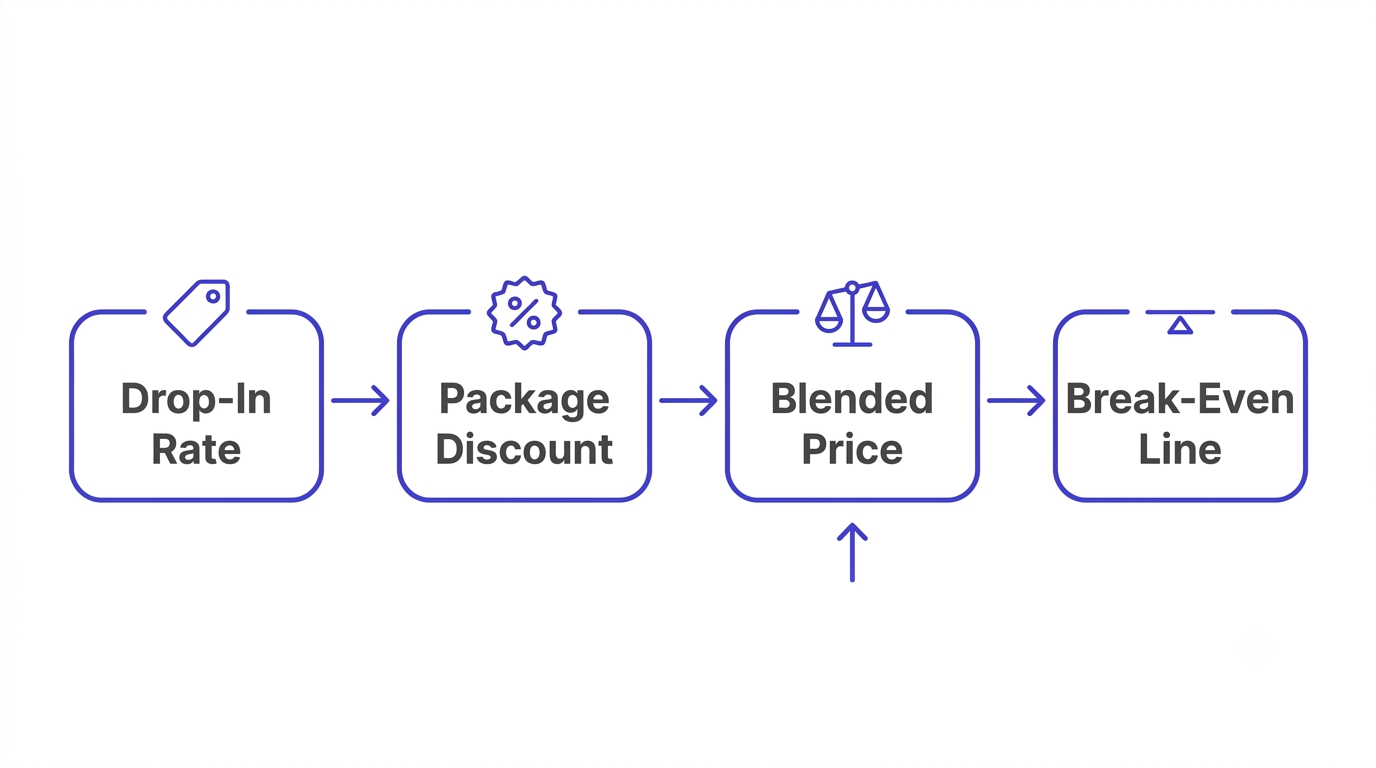
There is no universal answer because per-class value varies by format, market, and instructor cost, but the math behind a defensible 10-class price is the same everywhere: start from your drop-in rate, then discount only as far as your blended price (the average revenue per class across every package you sell) stays above your break-even cost per class.
Say your drop-in rate is $30 and your break-even cost, room, instructor pay, and overhead divided by classes run, is $18. A 10-class pack priced at $250 works out to $25 per class, a discount clients notice against the $30 drop-in, while still clearing break-even by $7 a class. Price that same pack at $200 and the per-class rate drops to $20, just $2 above break-even, so a single no-show-heavy month or an instructor rate increase erases the margin entirely. Run this math before you set a round-number price, not after.
Drop-In vs. Package vs. Membership: Which Should You Lead With?
Lead with the drop-in for anyone who has never taken a class at your studio, then use the package as the upgrade path once they have attended twice. That sequence converts better than pushing a 20-class commitment on a first visit. Recurring memberships work best once a studio has enough repeat attendance data to know its real churn rate, selling unlimited monthly access before that data exists tends to underprice a studio's busiest members.
Specialized formats price this sequence differently. A HYROX-style studio with expensive equipment and coached group sessions often skips the low-end drop-in altogether (the HYROX class pricing guide breaks down why), while a package built around what clients actually return to buy converts better than one built around what is easiest to administer, see selling packages clients actually buy.
How Do You Discount Packages Without Killing Margin?
Every pricing model trades a different amount of margin for a different kind of commitment, and the table below is the fastest way to see that trade-off side by side before you set a single price on anything. Session-based packs protect margin best; recurring memberships trade margin for predictability.
| Model | Typical discount vs. drop-in | What you're trading for it |
|---|---|---|
| Session-based (10-pack) | Roughly 15-20% below the per-class drop-in rate | A committed multi-visit sale with no ongoing obligation on either side |
| Session-based (20-pack) | Roughly 25-30% below drop-in | Deeper commitment, higher no-show risk per class if attendance dips |
| Recurring membership | Often the lowest per-class rate of all | Predictable monthly revenue, but only profitable once real attendance and churn are known |
| Shared/family package | Discounted per person, not per class | Higher upfront cash, but per-person attendance is harder to track without a shared-credit system |
The deeper the discount, the more the model depends on knowing your real attendance and no-show rate. Guessing here is what turns a full pack into a loss.
Run Every Rate Type Without the Spreadsheet Mess
The operational problem behind package pricing is rarely the math, it's running regular, member, promo, family, and ClassPass-discounted rates side by side without losing track of which one applies to which client. Vibefam Packages & Memberships runs all of those rate types on the same dashboard, with a credit system and smart card-retry on failed renewals so a declined card doesn't quietly turn into a lapsed member.
It's the exact messy-pricing pain operators describe: one Malaysian studio owner asked directly whether members could be "categorised in different groupings… after one year or two years they will see different prices" (Align Fitness, Malaysia, onboarding call, December 2024), a loyalty-tier structure most spreadsheet-based pricing can't track cleanly. Vibefam gives boutique studios comprehensive software across operations and marketing, so every package, membership, and promo rate runs through the same system that also handles your renewals, discounts, and payment processing. The real cost of studio payment processing is worth checking before you finalize package prices, since processing fees eat into the margin you just calculated. Book a free demo to see your own package mix modeled out.
When Should You Revisit Your Prices?
Revisit package pricing on a fixed schedule, not just when a client complains, because studios that only react to complaints tend to under-price for years before anyone raises the issue. Check your blended price against break-even whenever instructor pay, rent, or your busiest package's attendance changes.
If a specific package is selling well but its per-class rate sits close to break-even, that's the one to reprice first, not the slowest-selling option. In our observations supporting boutique studios across North America and APAC, the accounts that revisit pricing on a schedule catch margin erosion months before the ones that wait for a complaint. More on this in the pricing and revenue category.